When will we get here? I hope soon!

Your Nigerian education blogspot.

11/08/2013
Facebook, Twitter and YouTube - Useful for teachers and students in secondary and higher education

Many Nigerian schools are yet to adopt the type of thinking required by the Internet era. There still exists the thinking that originated in the old idea of learning to learn. A thinking which is now stale whether we choose to believe, accept and adopt it or not. The list is long - facilities such as the interactive whiteboards, computers or tablets as instructional materials; or the use of social media for high school students such as Facebook, Twitter, YouTube, Instagram etc which all serve as effective communication tool are mostly absent in the teaching-learning process.
Did you know that about 96 percent of students with internet access report using social networking technologies, and that three in five (59 percent) use these tools to talk about educational topics online? Maybe not as much in Nigeria because our access to the Internet is still growing.
Social media has revolutionised many industries, but perhaps its impact on the classroom, and the education system as a whole is the most striking. Whether it’s through the use of private social groups, Facebook Pages, classroom Twitter profiles, embracing these social networking is showing that, if used correctly, these platforms can have a positive impact on grades.

There are three main social media powerhouses that provide encouraging learning opportunities and they are Facebook, Twitter, and YouTube. These trilogy stand out amongst others because of their applicability.
Facebook: ideas are spread, opinions are voiced, and arguments are had. References from links found on other social media sites, as well as your own documents, can be posted openly for classroom discussions.
Twitter: students in a project who have a Twitter account will follow and/or create group pages on Twitter related to the subject of interest. Ideas are spread, important links are posted, research results and open discussions are diagnosed.
Youtube: You can find very educational information there. I have found many teaching/learning ideas on YouTube channels; I have viewed and shared many videos with my kids on fun ways to learn multiplication tables. There are loads of teaching ideas on any topic that comes to mind...algebra, geometry, reading comprehension, drama etc.
I hope teachers can begin to use these platforms to spread knowledge with their students as it not only promises to be fun and interactive, above all, it incites the use of the social media for fantastic learning opportunities. It is probably easier to get our students to do their assignments on it as they may spend ample time there. Students can now begin to use and view them as mediums for academic and society-oriented courses.
Teachers should give social media assignments in their classes or create a Facebook group for an entire class. Let us bring the classroom together on social media and enjoy the beauty of the changing landscapes it is brings to their world.
07/08/2013
Cramming - A popular curse of education in Nigeria
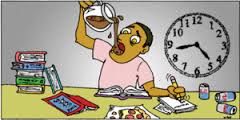
In education, cramming is the practice of working intensively to absorb large volumes of information and facts in short amounts of time. It is usually done by students in preparation for upcoming tests or exams, especially at the last minute. Educators discourage the use if cramming because the hurried coverage of material often results in poor long-term retention of material and leads to mediocrity. Rote learning is
I feel it is very important for students to memorize some math facts such as multiplication tables in younger children. The issue that often arises here is the method applied in the teaching process. I know it’s very important for primary school children to learn math facts and spelling words so that when they get older, they can easily pass through tests which often helps in building confidence. However, memorization or cramming does not have to come just by pure recitations which does not allow for critical thinking and in depth understanding. For example, multiplication tables can be learnt using templates of classic nursery rhymes and even rap songs. Spellings should be taught using visual aids because the brain is known to absorb what is seen often easier.
Cramming is becoming quite common among students at the primary, secondary and post-secondary level and I consider it a negative study technique. The pressure to perform well in the classroom often results in the cramming method of studying and Students are often forced to cram after improper time utilization or in efforts to understand information shortly before being tested. Improper time management is usually the cause for last-minute cramming sessions, and many study techniques have been developed to help students succeed instead of cramming. Active learning and critical thinking are great methods which emphasize the retention of material and facts through the use of class discussions, study groups and individual thinking.
For a long time, cramming or memorization has been used and is still used in many classrooms but they now belong in the past. Teaching students what to think instead of how to think keeps generations at a higher level of ignorance which seems to be apparent in our society these days. If children are made to think through active participation, they develop conceptual and analytical skills needed to help them excel in secondary and post secondary school.
“We forget those things if they’re just learned for the sake of the test.”
Neurologist Judy Willis of Edutopia goes even further saying that over-emphasis on rote memorization over-stresses the brain and detours our thinking away from the ‘rational, prefrontal cortex’ where higher-order thinking occurs.
We need to re-strategize our teaching methods. Technology is fast creeping in on us and we have to go with the tide. Two key strategies: ACTIVE LEARNING AND CRITICAL THINKING
02/08/2013
Let's blame ASUU --- university teachers

I worry when we lose track of our needs, redirect blame and seemingly continue to chase shadows. Upon whose shoulders should the task of ensuring our students are in school? Remuneration of teachers is as important as the teaching - learning process because their because their basic requirements must be secure. But that is not all!
In the 2009 Agreement, the government promised to provide fund for revitalising public universities; provide assistance to state universities; establish a Nigerian University Pension Commission, NUPEMCO, and progressively increase the annual budgetary allocation to education to 26 per cent between 2009 and 2020.
Government also promised to pay earned allowances, transfer federal government landed property to universities and to set up research equipment provision to laboratories and classrooms, the government has failed to keep its promises.
Why do some lay the blame on the Academic Staff Union of Universities (ASUU)? Why don't we demand accountability and discipline from our government once and for all? An agreement should not be breached abruptly!
Nigeria is fast becoming a euphoric state. There is increasingly a flagrant excessive interest in 'celebri-talk' and less 'real-talk' (I guess it keeps the people happy which I am not opposed to). However, we have real problems in our education system which as a people, we must work in agreement to tackle! Let's sign a petition that will end the ASUU Strike! Sign a petition to improve our schools, to get our children back to school and to implement our good policies on education! Together, we can save the future of this country; just by our relentless demand for the improvement of the quality of education in Nigeria. No nation can rise OR has risen above the level of their education.
We have been called the 'proverbial land of no tomorrow'.....sad! Education helps to eliminate poverty and in return, we are handed a sure tomorrow.
Education is preparation for life. Education is life itself ~ John Dewey
01/08/2013
8 ways parents discourage their kids from reading

No parent intentionally tries to discourage their child from reading. But sometimes our actions do just that. Kids may be resilient, but they are also really sensitive, and how we handle reading in our homes can work for or against our kids’ reading attitude. Once a child writes reading off, it’s much harder to reel them back in and get them to give it a second shot. Here are eight things to avoid .
1. Don’t put down your child’s reading materials. Comics and books with crude humour often get dragged through the mud, as do character-driven books. Their choices may not be your favorite, but when you say no to a book, what your child may hear is no to reading. Instead of banning their beloved reading material , find a way to add in some more desirable books into the mix.
2. Don’t provide the wrong level material. No one likes reading something that makes them feel stupid. If the books are too hard they will frustrate your child. If the books are too easy, they will bore your little reader. You don’t need to know your child’s exact level; their interest will let you know. Go to the bookstore or library when you have a chunk of time and let them explore. Take out a bunch of books and try them out. Find favorite authors and read everything they’ve written, then start again with a new author.
3. Don’t use reading as a punishment. Saying things like “Go to your bedroom and read!” or “If you do that again, I will make you go read.” sets kids up to associate reading as a negative thing. Keep punishments and reading separate.
4. Don’t forget to give your child books as a gifts. Gifts are special, and starting at birth books make the best gifts – especially if you read them with the person who gave them to you. Book fairs at schools are a great place for kids to get excited about books, and we use them as treats!
5. Don’t explain to your child they aren’t really reading yet when they are only looking at the pictures. If we tell our children they aren’t readers, they will believe it, and to a child this isn’t as fluid as it is for adults. They don’t see that reading is developmental, and this blow to their confidence can really stick with them. If they aren’t decoding words yet, let them know that they can “read the pictures” and tell the story that way until they can read the words too.
6. Don’t forget to let your kids see you read for fun. Studies show that kids with parents who read often for pleasure are more likely to read for fun themselves. So if you want a kid who loves to read, let them see you reading too.
7. Don’t over-correct and over-practice. It’s exciting when your child starts to read independently, but forcing them to read and reread text until they have it perfect is not the most effective way to encourage or instruct. Read with your new reader and help when they ask for it. If they miss a word but the meaning is intact, don’t interrupt. If the meaning of the sentence is all screwy, wait for a natural pause and ask them, “Did that make sense?” You can revisit the word if it didn’t. Use the pictures and the rest of the text as clues if the word is too tough to decode. If you have to do this often, the text is too hard for your child. Choose something easier, or if they are insistent take turns reading so there is some fluency being modeled.
8. Don’t forget to read to your kids. Every day. Even those days when you just want them to go to sleep already!! It makes all the difference.
www.notimeforflashcards.com
31/07/2013
Ways to Encourage a Strong Reader and Writer

Teachers don't expect kindergarteners to start reading and writing but they expect them to be good listeners, follow instructions and keep their impulses in check. You can help improve your child's readiness for reading and writing by trying out these tips.
1. Talk to your child to help them learn to speak and understand the meaning of words.
2. Ask questions that require more than one-word answers.
3. Read to your child everyday, hearing words help them become familiar with them.
4. Spend as much time listening and talking to your child as you do talking to him.
5. Create a quiet special place for your child to read, write and draw.
Reading well is the heart of all learning.
education.com
30/07/2013
Settling Over 10 million children

Do we need to settle the millions of children that are out of school? absolutely! Here's partly how the Minister plans to do it.
Minister of Education, Prof. Ruqayyatu Rufa’i, on Thursday last week said, the Federal Government was working to address the problem of the high number of out-of-school children.
The United Nations Educational, Scientific and Cultural Organisation report ranked Nigeria as the country with the highest number of out-of-school-children in the world, with 10.5 million of the 57 million children out of school in 2011.
Rufai said 125 day and boarding schools were being constructed under the Almajiri Education Programme. Eighty of these, she said, had been completed { while President Jonathan said 120 has been completed this week}... and a similar programme is targeting girl’s education,
According to her, comprehensive attention is being given to the development of new infrastructure and rehabilitation of existing ones to create access for additional pupils.
She revealed that government had earmarked an initial N15bn for the rehabilitation of laboratories in federal and state polytechnics, while another N109.4bn had been provided for universities, polytechnics and colleges of education in five phases under the High Impact Initiative of the Tertiary Education Trust Fund. Fifty-eight federal and state colleges of education are benefitting from the construction of micro-teaching laboratories at a cost of N11.6bn. This is to enhance the application of modern technology in the teaching-learning process.
According to the UNESCO report, the amount of aid to basic education which Nigeria received in 2011 was 28 per cent lower than it received in 2010. Nigeria is in the top 10 countries for the largest decrease in aid from 2010-2011.
LC: Again, it is not surprising to hear that the aid we receive for basic education has decreased. Why? Corruption in Nigeria can be seen by the youngest and untamed eyes. Getting these kids off the streets is an issue that must be addressed alongside if we are looking to be successful. Will there be provision for other needs - food, uniforms etc?
Let me say emphatically, that the government has come up with a few brilliant ideas, solutions and policies needed to begin solving the enormous problems facing the sector. However, we need to sign an armistice between policies and implementation! When we choose to keep out corruption and political bigotry, we will be in transit to a better educated country. I continue to be surprised that we have refused to keep education out of the mishmash and until we become experts at implementing policies, change seems far away.
Time is not our friend! Our neighbours, friends and foes are mostly all on an upward moving ride - open for clear discussions with experts on their way forward. Whether we like it or not, soon enough, the 'oil wells' will be desiccated. A good education system has all the answers! Mr 'To Whom It May Concern', lead us to that place..... where we will all be saved!
23/07/2013
Five Holiday Indoor Activities to Explore with your Kids
Parents and teachers alike worry about their students losing hard-earned skills over school breaks and even weekends. That's why so many parents work so hard to make sure their kids are learning, reading and growing. Here is a list of fun and easy at-home activities you can do to keep their knowledge fresh.

Encourage Journaling: Journaling is a great way to explore learning and practice writing. Encourage your child to journal using prompts. Or, Start a child and parent journal. Encourage your child to write about what they are reading. Then, write back to your child, asking him or her to elaborate or telling them about some of your favorite books. You could even ask them to write a chapter by chapter summary of chosen books read. Do encourage reading 'A-chapter-A-day' or 'A-book-A-day' depending on the age group. It could picture books for much younger kids that are not yet reading.

Let Your Kid Use Your iPhone (or iPod or iPad): We know you probably don’t want to give it up, but there are hundreds of top-rated educational apps for iPods, iPhones and iPads that will keep your kids engaged and learning.

Virtual Pen Pals: While social media tools like Facebook and twitter may be off-limits for your younger children, parents can encourage kids to stay in touch with classmates via private messengers or email. This not only gets them communicating, but it gets them writing and reading as well.

Create Learning Experiences Through Play: Set up a science experiment with rocks and seeds outside or create a "Mini med-school" with your kid's stuffed animals - kids love animals and I am about to explore this...bet it will be insightful. Even playing board games can be educational if you want it to be.

Incorporate Music into Their Learning: Music can be a great way to encourage vocabulary growth and even mathematical comprehension. So, pick up some favorite CD's, play songs from your Phones, iPads or computer and listen with your kids. Practice singing some known ones with them as you might just be discovering an innate talent.
Question for you: How do you keep your kids learning at this time?
22/07/2013
The Benefits of Failure - Games : A 'game changer'

Justin Marquis PH.D writes.....
Failure teaches many critical skills, among them:
Perseverance – Small failures that can be overcome teach students to keep trying until they succeed. There is little that we do in life or our jobs that is an instant success every time. Achievement is a process filled with incremental gains and small setbacks. Games involve players in this system and make it part of the learning process.
Resilience – Students must learn that their failures do not define them and that they are not made less by experiencing them. In fact, they are made better and stronger – more resilient – by facing them. This is something that they will require throughout their lifetimes and which the best games teach through adaptive difficulty levels.
Creativity – Seldom can a problem be solved by repeatedly doing the same thing over and over. More often than not, innovation is a key component to overcoming failures. The earlier that students learn this skill, the more proficient they will become at doing it. This ability to be creative in the face of adversity is something that defines the most successful members of an innovation-based economy and that is modeled in good games.
Adaptability – Students who encounter failures in their learning must also become adaptable in their approaches to solving problems and in their understanding of the way the world works. If you succeed every time, there is no challenge to your understanding of reality. If however, you encounter obstacles that must be overcome on the way to success you will learn that there are a wide range of reasons for that failure, possibly including fundamental flaws in your understanding of how the world works. Developing the flexibility to adapt to these changing understandings allows students to become successful in whatever context they may find themselves in the future.
How to ask for help - One thing that failure often prompts people to do is ask for help. This is, however, a learned skill that happens with intellectual maturity, and is not a natural part of many young people’s strategy for dealing with the world. Though it is one of the most successful strategies for learning.
Acting Independently - Many games also push players to act independently and decisively with little advanced notice. Failure to act quickly in a game will lead to losing more often than not, but players learn to adapt to being assertive agents of their own fate – what more could a prospective employer want?
www.onlineuniversites.com
Innovations in learning does not begin in success. Usually, you find that when one fails at a given task, innovation causes them to discover one more way of doing it differently a next time.
18/07/2013
He hawked bread for 3 years...

In his wildest imagination, he never believed he could be a university graduate, let alone a vice-chancellor. But Prof. Debo Adeyewa is now the Vice-Chancellor, Redeemer’s University, Mowe, Ogun State.
From being a pupil in a quranic school, to an apprentice carpenter and a bread seller on the streets of Jos, the Inisa, Odo-Otin Local Government Area of Osun State-born Adeyewa endured poverty and deprivation to seek education.
“I was born in 1957. That was the year the first satellite was sent to space. We were so poor that my father had to work as a labourer on another man’s farm before we could eat. It was that bad.
“One day, my uncle, who was a carpenter, came from Jos. When he was going back, I followed him to learn the work of a carpenter. In Jos, I was learning this and at the same time selling bread for people to raise money to feed. We later moved to Yauri, in present Kebbi State, where I continued the trade, helping women to sell bread,” he recalls.
At Yauri, he attended a technical college between 1978 and 1980. After the completion of the technical college, he sat for the then General Certificate of Education examination. His result was good enough to secure admission for him to the University of Ife, (now Obafemi Awolowo University), Ile-Ife, Osun State.
With a collaboration between OAU and Meteorology University, Uppsala, Sweden, Adeyewa obtained a PhD degree in satellite meteorology.
“The story of my life, so far, has taught me never to look down on anybody and to know that without God, I cannot do anything. My advice to ‘helpless’ youths is to know that things are better now than they were before now. They should find opportunities. I found opportunities in selling bread, though it was not easy. I looked at my life as an investment. So, they should look at theirs like that too.
“They should believe in God and in themselves. They should be disciplined, should have integrity, pursue excellence, embrace team work and always be ready to offer service to anybody that needs their services, Adeyewa adds.
LC: Inspirational isn't it? Yes, we should encourage our youth to have integrity, embrace team work and to be caring! How do we do this? The period of developing the spirit of cooperation and communication is best harnessed at the early childhood education stage which the government has left in the hands of the private sector with minuscule supervision if any. We are yet to hand down decent education to the millions of students around our public schools. I hate to say that using what is obtainable at the private schools to judge the level of our academia, is like comparing the lifestyle of our public office holders to the well being of the populace.
Additionally, we may want to scratch the part that says that, things are better now than they were before! We know they are not! The educational opportunities that presented at that time are not obtainable in the same way; there are much more people applying for so little opportunities. The Universal Basic Education (UBE) has a great framework upon which his positions should thrive but it seems as though we have become experts at botching implementation of policies.
Finally, I believe that against all odds, one who has opportunities presented their way merged with a natural knack for learning could certainly make a good career as he did. We are a 'certificate driven' nation and until those who are responsible for implementation of the current UBE program become 'born again' or 'radicalized', it may be a tough call to realize the good Professor's hopes.
So, I encourage everyone who has to struggle through to school to keep at it. Prof. Adeyewa is an 'OUTLIER'; pure and simple! To the positive mind, much availeth!
16/07/2013
Into the minds of 10-year old Nigerian kids
 |
| Mr Jimi Disu and I |
I had the privilege of being on a radio program called 'The Discourse' with Mr Jimi Disu on Classic FM 97.3, Lagos. I also had an 'aha' moment being on the programme two Sundays ago as it has certainly become one of those experiences I would always remember. A group of four 10 year olds took us on a trip into their thoughts about Nigeria. One thing stuck with me; they are aware of the putrefaction that is currently holding sway in Nigeria and they want NOTHING to do with it.
I left with a great sense of hope believing that our children are becoming aware of the necessity for change. Asked if they would want to become political office holders in the future, they all unanimously said "NO"! Shocking, isn't it? Can't say the same for my 7 year old son who has one of his dreams to become the President of Nigeria. We tell him that he must begin his journey by growing up to be a man of example, one who will match his words with actions, one of exemplary character and intelligence. He always gets excited as that is for him, the easier part (in his words)!
I was equally proud of the kind of education these 10 year olds have been exposed to (all private schools). However, I sadly acknowledge that I cannot confidently say the same for majority of Nigerian kids who have to be in our public schools. Hence, these sensitive perceptions and conclusions made by the four kids on the program do not represent the views of our average 10 year old in the country today. I can say that we have a growing population that are significantly well educated who can make corrections by commensurate thought processes, important discourse and actions.
The kids on the program were articulate and informative - an expository essay of what may become Nigeria tomorrow.
Here are some photos from the show with the kids and I. Great kids!
 |
| lovely kids |
 |
| I was quite surprised at some of their views! |
02/06/2013
How To Raise A Gifted Child

In my usual researchers' mode, I stumbled on this and I knew instantly it was a 'must-share'. Now, I intend to do more of all the activities spoken about, however, the raising of a 'gifted child' may not be an appropriate terminology since the parameters for measuring a gifted child is evolving. Interestingly, you are ultimately guaranteed of raising a brilliant and resourceful child with a good measure of success. And you will never go wrong with the 'read, read, read' practice. It always works. Read and do practice.
Talk, talk, talk. Ask your kid open-ended questions, like “What would happen if we stopped for ice cream on the way to the beach?” Such questions help a child reflect on what he knows and tell him his opinion matters. Don't worry if he's too young to understand. Likewise, don't be afraid to use relatively sophisticated words. They would figure it out if familiar multiple words are used alongside.
Read, read, read. Research has repeatedly shown that access to books and one-on-one reading time is a predictor of school success. “Reading stimulates the brain to make connections and builds background knowledge about the world,” says Kim Davenport, chief program officer at Jumpstart, a national early-literacy organization. “Reading is the foundation of all learning and will enable a child to absorb and apply content from all areas, including math and science.” Modeling good reading habits may give them an edge. “Seeing parents reading for enjoyment will be contagious,” says Davenport. Invite your child to cozy up on the couch with you to read. Keep books out—in baskets, on shelves, and on coffee tables. And share what you're reading with your child, and ask him to do the same. This will not only spark conversation but build his vocabulary and comprehension.
Praise results. Instead of just saying "you are a star". Say that you are a star for solving this or that problem.
Giving the right props is key, says Stephanie Rosales, a licensed educational psychologist in La Quinta, CA: “Children who are praised for solving a problem tend to be more motivated in school than children who are told they're smart. The latter, ironically, often become frustrated when something doesn't come easily.” Say stuff like "I like the way you figured out how to solve this problem".
Seize teachable moments You can help your child sharpen school skills as you go about your day. Say you drive by a windmill. Instead of saying “Hey, a transformer!” ask a question: “What do you think they do?” Encouraging observation of details will help your child do the same in class, says Rosales. And a trip to the store can be a chance to build vocabulary, math skills, and money smarts. Tell a 2-year-old the names of fruits as you bag them. Ask a 3-year-old to find four cans of drinks. Have a 5-year-old write down which cereal she wants. Older kids can compare prices and sizes.
Whether your child is advanced or average, the best thing you can do is be involved. Taking them on this journey of self-discovery is what'll drive their personal genius. In one word: What do you most want your kid to be? Happy? Funny? Confident? Loved? I am betting that many of us will say even silently a “Professor of Science". Your goal is to help your child be the best he or she can be, right? So, use all of the above to discover what their strengths are.
Resist the urging temptation to praise your child for every "OK" job they do so they don't get stuck in not learning to take responsibility for actions taken.
www.parenting.com
14/05/2013
Watch this Inspiring Video: Kids don't learn from people they don't like
Rita F. PIERSON inspires me. I love this speech.
True! Kids don't learn from people they don't like. All learning comes from understanding. An understanding that is nurtured by relationships. How I wish that all educators will appreciate the power of relationships in every learning situation.
To my colleagues, it is obvious that we will 'TEACH' anyway. Let's inspire our students each day by establishing good relationships first. Why? We are in the business of building lives.
05/05/2013
Watch This Video: How to Engage Under-performing Students
A new sense of educational order needs to emerge in our schools such that there will be new relationships and interaction between teachers and students which will in turn bring about a new concept of our curriculum.
Two key strategies here are: Interactive Learning and Non-Negotiables. Watch and share this important strategy that changed the story of one school from almost being shut down.
04/05/2013
4 Common Pronunciation Mistakes That Could Drive One Crazy

I read this from an education blogger called Shelley Emling and I was kind of surprised that the 'owners' of the language get it wrong too. Whether we disown or accept English language as ours, it is proper and polite to pronounce it well - especially when one is nabbed in the habit of 'phonology'.
1. Used/Use
If you've previously done something, you USED to do it. For example, one would write or say "I used to go running, but then I broke my leg." One would not write or say "I use to go running, but then I broke my leg."
2. Various words with the letter "x" or "x" sound
When you say "escape" it is "es-cape" and not "ex-cape." And when you say "ask" it is ass-k" and not "axe." Also, it is ex-cept and not es-cept.
3. Supposedly
There simply is no such word as "supposably." And it's "supposed to" and not "suppose to."
4. Anyway/anyways
Come on... there is no "s" at the end of the word "anyway."
I actually feel bothered especially in the X in place of S or vice versa - it is so wrong people! The 'used' term is a nice awakening because it is taken for granted here in Nigeria more often than should be. The 'suppose to' is common pronunciation mistake here and should be corrected.
For 'anyways' Shirley, my disclaimer as it pertains to its use is that it is often used more as a slang than a proper word.....but this is not to dilute its wrongness.
Click to read her post here.
28/04/2013
Never Give In, Never Give In, Never Never Never!
 "Never give in. Never give in. Never, never, never, never — in nothing, great or small, large or petty — never give in, except to convictions of honor and good sense." Winston Churchill, 1941
Winston Churchill repeated a grade during elementary school and, when he entered Harrow, was placed in the lowest division of the lowest class. Later, he failed the entrance exam twice to the Royal Military Academy at Sandhurst. He was defeated in his first effort to serve in Parliament. He became Prime Minister at the age of 62. He later proclaimed to the students of Harrow School {his alma mata), after becoming the Prime Minister the above speech.
No leader in history, perhaps, matched Churchill's capacity for blurring the lines between speech and battle cry. This is one of his best. It's an urban legend that the "Never give in" exhortation comprised the totality of his address; Churchill went on for several more paragraphs. But there's no question that this, far and away, was what Harrow's students remembered.
What lessons can we learn from Winston Churchill's speech to the students. Remember he had become a leader at the time of this speech.
- Firstly, every child has the potential to be someone great whether they are topping the class or not.
- Secondly, he was persistent and was positive until he became successful. Here, I speak directly to the parents who think their children are not doing great in school. Be persistent and patient, do not give up, keep working with your child and ensure that they bring the best of their ability. You are sure to raise an accomplished child in the future.
- Lastly, Churchill was a leader who cared about the perceptions and character of the students. Our eyes are collectively filled with tears, begging and seeking for leaders who will take Nigeria to the next level. Your words (leaders), if pronounced passionately with sustainable intent will change Nigeria.
And guess where 'change' will start from? THE SCHOOLS.
Give them your voice and support. Therein lies the magic!
26/04/2013
Big Big Words! Vanity upon Vanity
 From a page on this blog - Anecdotes of My Day...
constitutes my daily experiences. link
Big, Big Words!
Doing a lot of reading recently and I am totally enjoying all the new information I am getting. One terminology that has refused to leave me is NIHILISM. Nihilism is a state of nothingness. Nihilism is loss of meaning or seriousness. If nihilism were complete there would be no significant private or public issues. Nihilism is the fundamental movement in the history of the West. Materialism is a symptom of nihilism. Materialism is the view that all meaning has gone from the cosmos, nature, and culture. Values are objective, explicit options which imply the existence of choice. (Source: ERIC)
Is life itself meaningful? Now the bottom line here is that in the state of a loss of meaning, all educational activity lacks meaning with particular reference to cultural practices. Example, a close friend of mine does not really get why she needs to teach her kids her local language. Her argument is that it is meaningless and not useful to him! Is he going to become the business mogul she knows he will become through the use of the language? In his time, how many people is he going to have to speak it to? Is it for survival?
If we look at her 'nihilist' arguments for the transmission of language deeply, we may begin to see reasons. In the transmission of values, a good question to ask ourselves constantly is..."does it have meaning?"
Now, here I am in my world, thinking, if so, many cultural practices are valueless - in a state of nothingness. If they are valueless, what makes a people unique? Are we human beings equally in a state of nothingness - nihilism? Do you get my drift? If you do, you are definitely in 'the spirit' with me because I guess we must find some meaning at some point as human beings.... otherwise we need not exist.
Now, here I am in my world, thinking, if so, many cultural practices are valueless - in a state of nothingness. If they are valueless, what makes a people unique? Are we human beings equally in a state of nothingness - nihilism? Do you get my drift? If you do, you are definitely in 'the spirit' with me because I guess we must find some meaning at some point as human beings.... otherwise we need not exist.
20/04/2013
Is the teaching of handwriting still important in this technology driven age?

Is handwriting still important? Educators are saying that basic handwriting skills are still necessary for success in schooling and life. I play a dual role as a mother/teacher and I have found it extremely hard to get my son to write the way I would love him to. I see his 'excitability' in his pattern of handwriting. He just won't settle to write well a lot of times but teaching him to write frequently is helping him learn to be more detailed. It has worked on his study skills and his spellings.
Fears of handwriting's demise prompted North Carolina Congresswoman Pat Hurley to draft a bill, mandating that script be taught in all elementary schools in the state. It passed unanimously in the state House earlier this month.
Jeffrey Reaser, an associate professor of linguistics at North Carolina State University, says a sense of "nostalgia" is not enough reason to force students to learn something that's "not crucial to their education".
Meanwhile, some classrooms in the state have begun teaching students handwriting on iPads and iPods.
I think that it is important because it helps children acquire the skill of writing by hand almost as they would a second language. It is wise to continue teaching handwriting and we need to continue to help kids be 'bilingual' by hand.
There is still a clear emphasis on maintaining those building blocks within the education system. Some experts conducted a study that looked at the ability of students to complete various writing tasks — both on a computer and by hand.
The study, published in 2009, found that when writing with a pen and paper, participants wrote longer essays and more complete sentences and had a faster word production rate.
In a more recent study, they looked at what role spelling plays in a student's writing skills and found that how well children spell is tied to how well they can write.
"Spelling activates some of the thinking parts of the brain in the frontal lobes." one expert said. "We think that it is a cognitive portal, because it helps us access our vocabulary, word meaning and concepts … It is allowing your written language to connect with ideas."
Spelling helps students translate ideas into words in their mind first and then to transcribe "those word representations in the mind into written symbols in the external environment (on paper or keyboard and monitor)," the study said.
Seeing the words in the "mind's eye" helps children to not only turn their ideas into words, says Berninger, but also to spot spelling mistakes when they write the words down and to correct them over time.
In our computer age, some people believe that we don't have to teach spelling because we have spell checks. But when a child has a functional spelling ability of about a fifth grade level, they won't have the knowledge to choose the correct spelling among the options given by the machine."
I dare to say that hand writing has a lot to do with discipline, clarity of thought and ability to focus. But then perhaps, these are not considered useful things any more in this "copy and paste age". I'm wondering! Have you noticed that an increasing number of people can not spell correctly any more?

There is still a clear emphasis on maintaining those building blocks within the education system. Some experts conducted a study that looked at the ability of students to complete various writing tasks — both on a computer and by hand.
The study, published in 2009, found that when writing with a pen and paper, participants wrote longer essays and more complete sentences and had a faster word production rate.
In a more recent study, they looked at what role spelling plays in a student's writing skills and found that how well children spell is tied to how well they can write.
"Spelling activates some of the thinking parts of the brain in the frontal lobes." one expert said. "We think that it is a cognitive portal, because it helps us access our vocabulary, word meaning and concepts … It is allowing your written language to connect with ideas."
Spelling helps students translate ideas into words in their mind first and then to transcribe "those word representations in the mind into written symbols in the external environment (on paper or keyboard and monitor)," the study said.
Seeing the words in the "mind's eye" helps children to not only turn their ideas into words, says Berninger, but also to spot spelling mistakes when they write the words down and to correct them over time.
In our computer age, some people believe that we don't have to teach spelling because we have spell checks. But when a child has a functional spelling ability of about a fifth grade level, they won't have the knowledge to choose the correct spelling among the options given by the machine."
I dare to say that hand writing has a lot to do with discipline, clarity of thought and ability to focus. But then perhaps, these are not considered useful things any more in this "copy and paste age". I'm wondering! Have you noticed that an increasing number of people can not spell correctly any more?
14/04/2013
What is wrong in this picture?

My husband has a friend who believes strongly in flogging or whipping his children and of course using the corporal punishment. He says they are turning out to be the best behaved students in their school. I read this and I think it is worth reading.
Think of being fed and clothed by children you had whipped -- whose flesh you had scarred! Think of feeling in the hour of death upon your withered lips, your withered cheeks, the kisses and the tears of one whom you had beaten -- upon whose flesh were still the marks of your lash! The whip degrades; a severe father teaches his children to dissemble; their love is pretence, and their obedience a species of self-defence. Fear is the father of lies.
We all know of many instances where the abused, the maligned, and the tortured have returned good for evil -- and many instances where the loved, the honored, and the trusted have turned against their benefactors, and yet we know that cruelty and torture are not superior to love and kindness.
When the children are young and weak, the parents and teachers who are strong beat the children in order that they may be affectionate/perform excellently. Now, when the children get strong and the parents and teachers are old and weak, should the children not beat them, so that they too may become kind and loving or deserving/exemplary?
Do tell! Do you not think that this picture will only do more harm than good? I am a teacher and I have indeed got the best out of my students without ever using this 'hideous' and 'soul-impoverishing' method! The 'post-stone' age period is long gone. Perhaps, we might be breeding unmindful citizens.
Back To Blogging!

Once again, I have been unavoidably absent for a much longer time than I'd hoped for. I have been attending to very many matters that are gainful....but I am baaacckkk! However, I will be writing my exams in school soon (currently running a Masters program) and I'm hopeful that I should be able to dazzle my lecturers having learnt so much in such a little time.
I have a little advice; do not just read novels or soft sell magazines. There is a lot information available for the taking. Read journals, articles, abstracts, self-help books and most importantly educating textbooks of interest in your field. In Dr. Igwe's (Curriculum Theory Ph.D) words, "READ WIDELY!" You will be amazed at how much good you will be doing to yourself. You gradually become your own little encyclopedia.
I promise to be as constant as the rising sun (smile). Thanks to as many that continued to follow the blog. You are appreciated.
Subscribe to:
Posts (Atom)